Home / Practice Standards & Resources / Infographics / 14 Reasons Why Schools Need an Educational Audiologist
14 Reasons Why Schools Need an Educational Audiologist
EAA Infographic · 2026
Approved by the EAA Board of Directors, February 2026
Educational audiologists are uniquely qualified professionals who play a critical role in supporting students with hearing loss and auditory disorders in school settings. Their expertise spans evaluation, technology, training, and collaboration — ensuring that every student has equitable access to communication and learning. The following 14 reasons outline the distinct and essential services that educational audiologists provide that cannot be fully replicated by other school-based professionals.
Get this resource
Three ways to use it: post it, share it online, or hang it on the wall.
One page infographic
Print it for the staff room, drop it into a board presentation, or attach it to an email.
Infographic (PNG image)
Social media kit
Ready made posts for sharing the fourteen reasons through your own channels.
Social posts (ZIP)
Printed poster
A matte vertical poster for the clinic, the front office, or your own door. Sold through the EAA shop.
Buy the poster (EAA shop)
Browse all EAA infographics
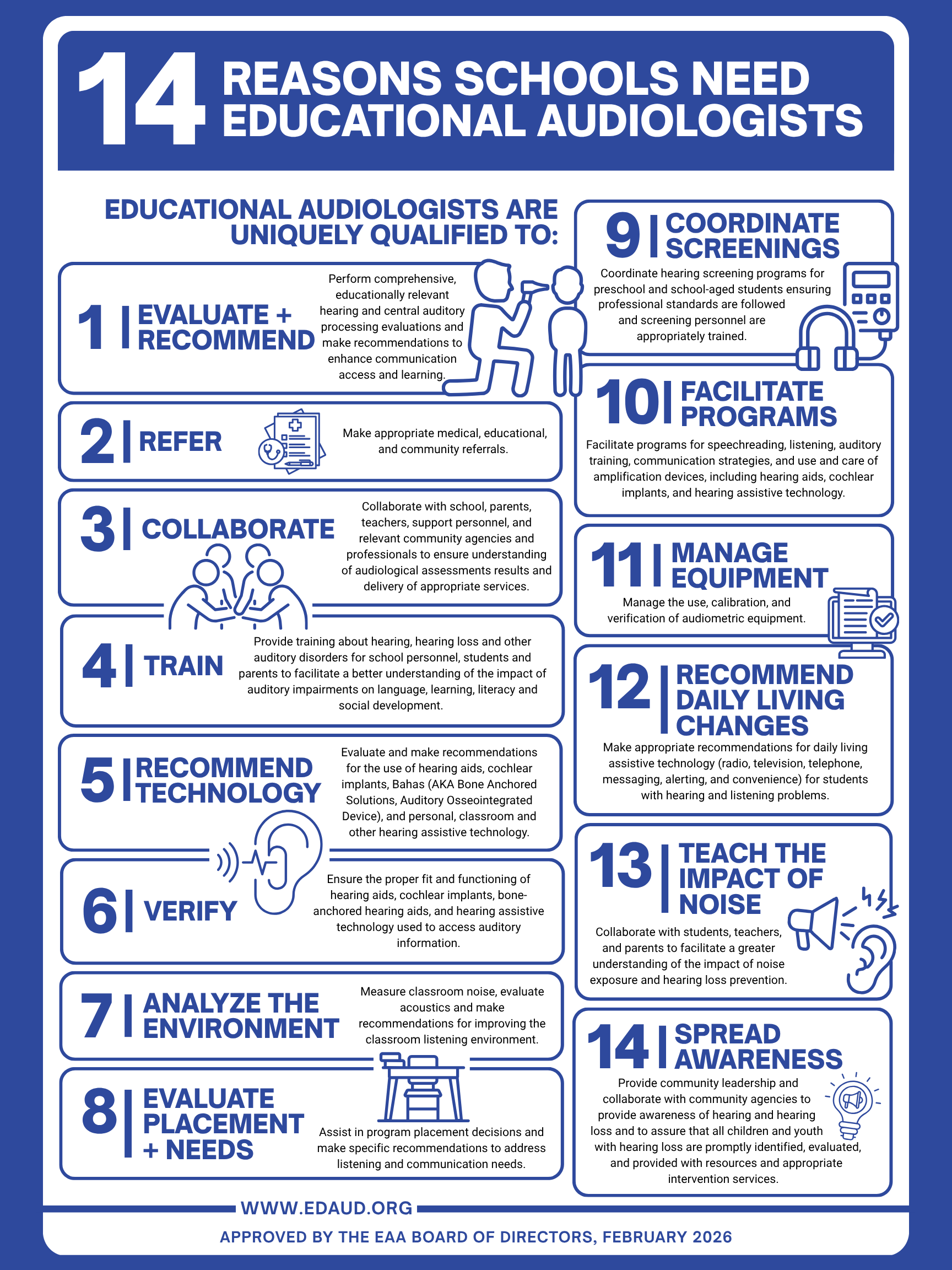
Select the image to open it at full size. The complete text follows.
What this infographic says
The wording below is taken from the infographic itself, unchanged.
Educational audiologists are uniquely qualified to:
- 1
Evaluate + Recommend
Perform comprehensive, educationally relevant hearing and central auditory processing evaluations and make recommendations to enhance communication access and learning.
- 2
Refer
Make appropriate medical, educational, and community referrals.
- 3
Collaborate
Collaborate with school, parents, teachers, support personnel, and relevant community agencies and professionals to ensure understanding of audiological assessment results and delivery of appropriate services.
- 4
Train
Provide training about hearing, hearing loss and other auditory disorders for school personnel, students and parents to facilitate a better understanding of the impact of auditory impairments on language, learning, literacy and social development.
- 5
Recommend Technology
Evaluate and make recommendations for the use of hearing aids, cochlear implants, Bahas (AKA Bone Anchored Solutions, Auditory Osseointegrated Device), and personal, classroom and other hearing assistive technology.
- 6
Verify
Ensure the proper fit and functioning of hearing aids, cochlear implants, bone-anchored hearing aids, and hearing assistive technology used to access auditory information.
- 7
Analyze the Environment
Measure classroom noise, evaluate acoustics and make recommendations for improving the classroom listening environment.
- 8
Evaluate Placement + Needs
Assist in program placement decisions and make specific recommendations to address listening and communication needs.
- 9
Coordinate Screenings
Coordinate hearing screening programs for preschool and school-aged students ensuring professional standards are followed and screening personnel are appropriately trained.
- 10
Facilitate Programs
Facilitate programs for speechreading, listening, auditory training, communication strategies, and use and care of amplification devices, including hearing aids, cochlear implants, and hearing assistive technology.
- 11
Manage Equipment
Manage the use, calibration, and verification of audiometric equipment.
- 12
Recommend Daily Living Changes
Make appropriate recommendations for daily living assistive technology (radio, television, telephone, messaging, alerting, and convenience) for students with hearing and listening problems.
- 13
Teach the Impact of Noise
Collaborate with students, teachers, and parents to facilitate a greater understanding of the impact of noise exposure and hearing loss prevention.
- 14
Spread Awareness
Provide community leadership and collaborate with community agencies to provide awareness of hearing and hearing loss and to assure that all children and youth with hearing loss are promptly identified, evaluated, and provided with resources and appropriate intervention services.
Resources and references
Where the fourteen reasons come from, and what to reach for when you are making the case in your own district. All links were checked in August 2026. If a link stops working, please let us know.
The standards behind this list
EAA guidance defining what educational audiologists are qualified to do.
Making the case in your district
What to pair with this infographic when you take it to an administrator or a school board.
Keep Exploring
Make the Case
Advocacy tools for demonstrating the value of educational audiology services.
View topic →
Go Deeper
Forms, guides, and external resources for day to day school audiology practice.
Open the library →
|