

|
Home / Practice Standards & Resources / Infographics / A Team Approach to Hearing Assistive Technology A Team Approach to Hearing Assistive TechnologyEAA Infographic · 2026 How a school team shares responsibility for hearing assistive technology: what HAT is, who is qualified to select, fit, and verify it, what each team member contributes, and the red flags that mean the team needs to act. The full text of the infographic is on this page. Download and shareFree to print, post, and pass along to staff and families. 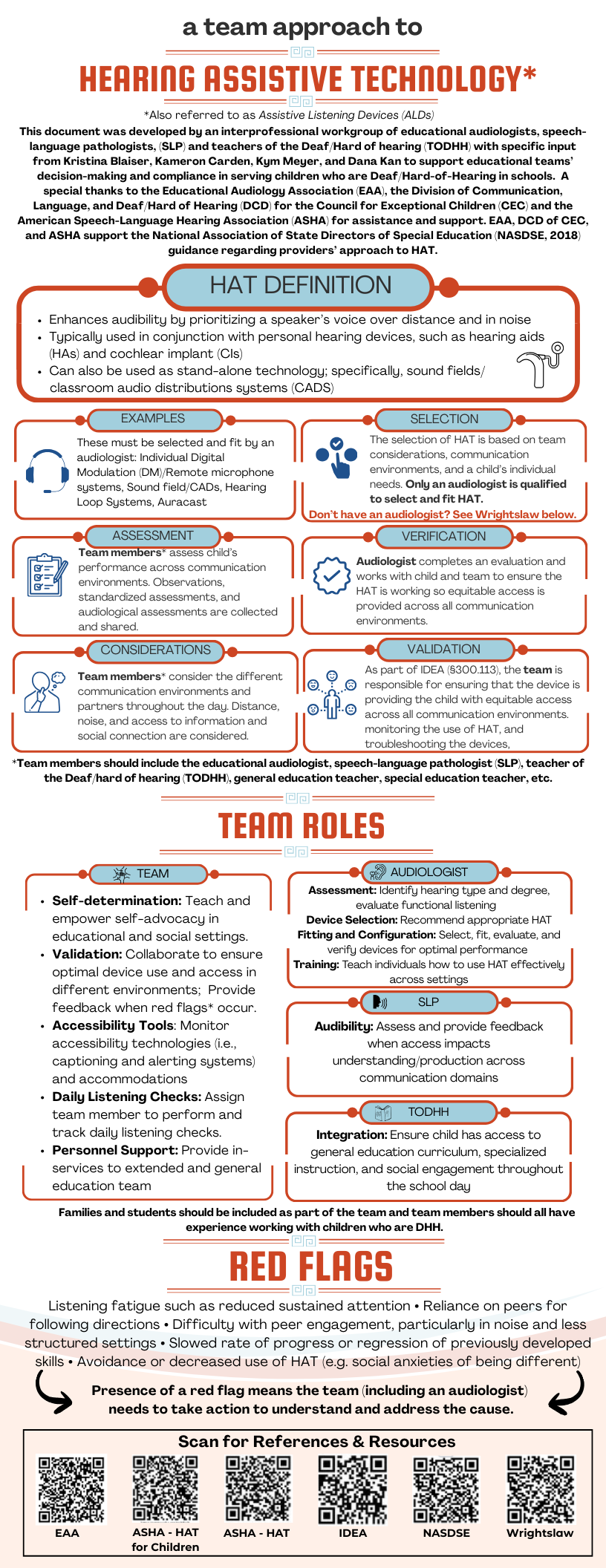
Select the image to open it at full size. The complete text follows. What this infographic saysThe wording below is taken from the infographic itself, unchanged. Hearing assistive technology is also referred to as Assistive Listening Devices (ALDs). HAT Definition
ExamplesThese must be selected and fit by an audiologist: Individual Digital Modulation (DM)/Remote microphone systems, Sound field/CADs, Hearing Loop Systems, Auracast SelectionThe selection of HAT is based on team considerations, communication environments, and a child’s individual needs. Only an audiologist is qualified to select and fit HAT. Don’t have an audiologist? See Wrightslaw. AssessmentTeam members* assess child’s performance across communication environments. Observations, standardized assessments, and audiological assessments are collected and shared. VerificationAudiologist completes an evaluation and works with child and team to ensure the HAT is working so equitable access is provided across all communication environments. ConsiderationsTeam members* consider the different communication environments and partners throughout the day. Distance, noise, and access to information and social connection are considered. ValidationAs part of IDEA (§300.113), the team is responsible for ensuring that the device is providing the child with equitable access across all communication environments, monitoring the use of HAT, and troubleshooting the devices, *Team members should include the educational audiologist, speech-language pathologist (SLP), teacher of the Deaf/hard of hearing (TODHH), general education teacher, special education teacher, etc. Team RolesTeam
Audiologist
SLPAudibility: Assess and provide feedback when access impacts understanding/production across communication domains TODHHIntegration: Ensure child has access to general education curriculum, specialized instruction, and social engagement throughout the school day Families and students should be included as part of the team and team members should all have experience working with children who are DHH. Red Flags
Presence of a red flag means the team (including an audiologist) needs to take action to understand and address the cause. Where the infographic’s QR codes leadThe printed version ends with a “Scan for References & Resources” block of six codes. Those destinations are: How this resource was developedThis document was developed by an interprofessional workgroup of educational audiologists, speech-language pathologists (SLP), and teachers of the Deaf/Hard of Hearing (ToDHH) with specific input from Kristina Blaiser, Kameron Carden, Kym Meyer, and Dana Kan to support educational teams' decision-making and compliance in serving children who are Deaf/Hard-of-Hearing in schools. A special thanks to the Educational Audiology Association (EAA), the Division of Communication, Language, and Deaf/Hard of Hearing (DCD) for the Council for Exceptional Children (CEC) and the American Speech-Language Hearing Association (ASHA) for assistance and support. EAA, DCD of CEC, and ASHA support the National Association of State Directors of Special Education (NASDSE, 2018) guidance regarding providers' approach to HAT. Resources and referencesThe documents this infographic points to, plus the EAA pages that go further on hearing access technology. All links were checked in August 2026. If a link stops working, please let us know. Referenced on the infographicThe regulation and the guidance named in the text above.
Go further on edaud.orgEAA guidance on the technology and the roles around it.
Suggested citationEducational Audiology Association. (2026). A team approach to hearing assistive technology [Infographic]. https://www.edaud.org/infographic--a-team-approach-to-hat Keep ExploringThe Technology
Hearing Access TechnologySelecting, fitting, verifying, and managing listening technology for students. Go Deeper
Resource LibraryForms, guides, and external resources for day to day school audiology practice. |