

|
Home / Practice Standards & Resources / Infographics / Remote Microphone Hearing Assistive Technology for Education Remote Microphone Hearing Assistive Technology for EducationEAA Infographic · 2024 Remote microphone hearing assistive technology is designed to provide improved auditory access in the presence of noise and/or distance. The speaker wears a microphone, and their voice is sent wirelessly to a receiver worn by the listener. Download and shareFree to print, post, and pass along to staff and families. 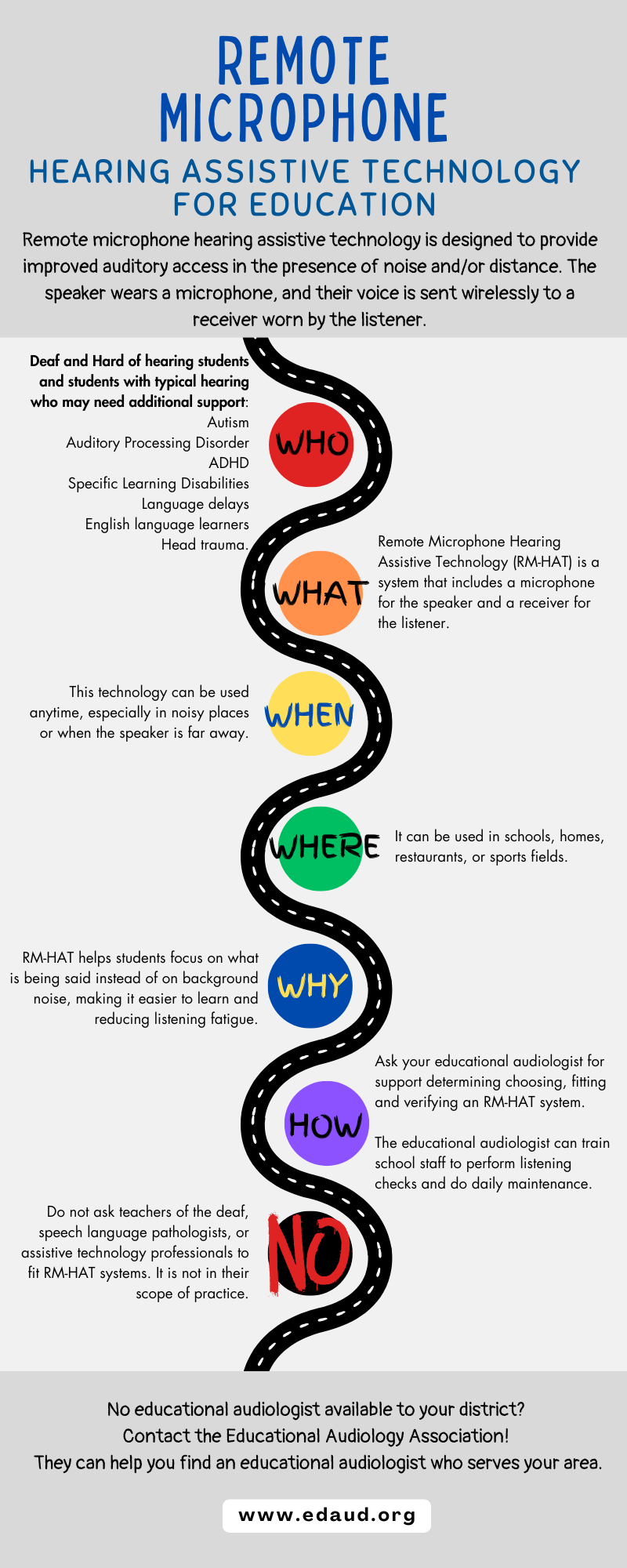
Select the image to open it at full size. The complete text follows. What this infographic saysThe wording below is taken from the infographic itself, unchanged. WhoDeaf and Hard of hearing students and students with typical hearing who may need additional support:
WhatRemote Microphone Hearing Assistive Technology (RM-HAT) is a system that includes a microphone for the speaker and a receiver for the listener. WhenThis technology can be used anytime, especially in noisy places or when the speaker is far away. WhereIt can be used in schools, homes, restaurants, or sports fields. WhyRM-HAT helps students focus on what is being said instead of on background noise, making it easier to learn and reducing listening fatigue. HowAsk your educational audiologist for support determining choosing, fitting and verifying an RM-HAT system. The educational audiologist can train school staff to perform listening checks and do daily maintenance. Important NoteDo not ask teachers of the deaf, speech language pathologists, or assistive technology professionals to fit RM-HAT systems. It is not in their scope of practice. No educational audiologist available to your district? Contact the Educational Audiology Association! They can help you find an educational audiologist who serves your area. Resources and referencesWhat to read next on fitting, verifying, and managing remote microphone systems in school. All links were checked in August 2026. If a link stops working, please let us know. The technologySelecting, fitting, verifying, and managing hearing access technology for students.
Whose job it isThe scope of practice documents behind the Important Note above.
Suggested citationEducational Audiology Association. (2024). Remote microphone hearing assistive technology for education [Infographic]. https://www.edaud.org/infographic--remote-microphone-hearing-assistive-technology-for-education Keep ExploringThe Topic
Hearing Access TechnologySelecting, fitting, verifying, and managing listening technology for students. Go Deeper
Resource LibraryForms, guides, and external resources for day to day school audiology practice. |