

|
Home / Practice Standards & Resources / Infographics / The Impact & Importance of Hearing Screenings The Impact & Importance of Hearing ScreeningsEAA Infographic · 2021 Why screening beyond the newborn period matters, what unidentified hearing loss costs a child and a system, and why an audiologist belongs in the screening program. For sharing with administrators, school nurses, teachers, and anyone deciding how screening gets done. The full text of the infographic is on this page. Download and shareFree to print, post, and pass along to staff and families. 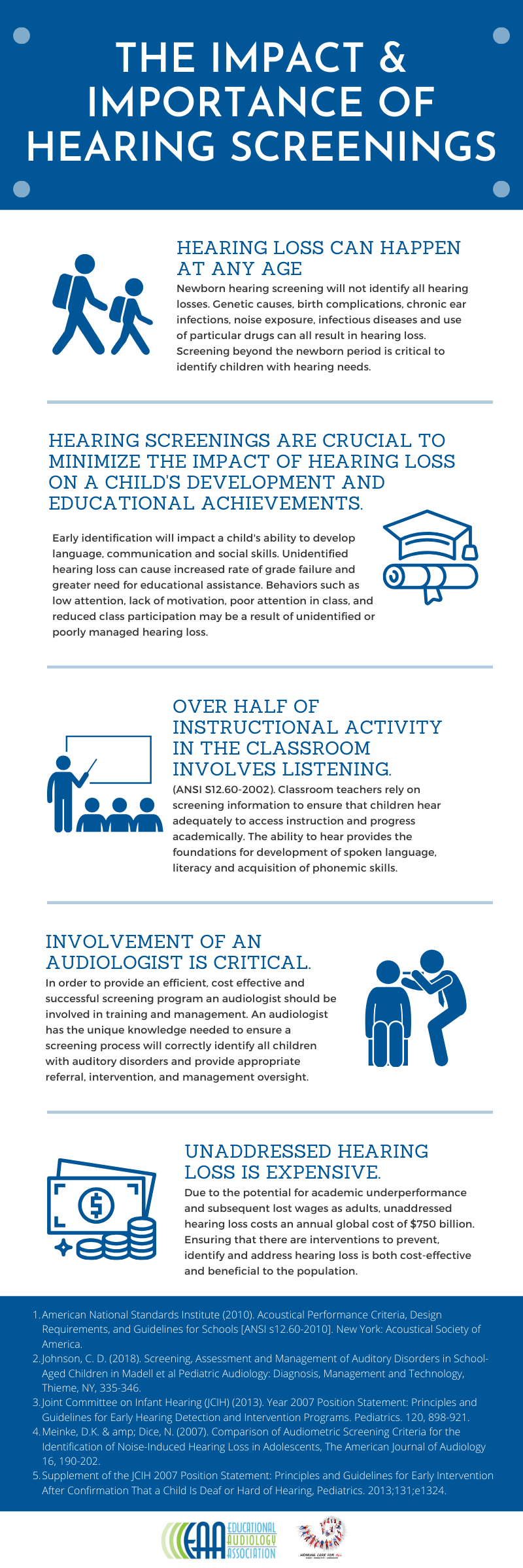
Select the image to open it at full size. The complete text follows. What this infographic saysThe wording below is taken from the infographic itself, unchanged. Hearing Loss Can Happen at Any AgeNewborn hearing screening will not identify all hearing losses. Genetic causes, birth complications, chronic ear infections, noise exposure, infectious diseases and use of particular drugs can all result in hearing loss. Screening beyond the newborn period is critical to identify children with hearing needs. Hearing Screenings Are Crucial to Minimize the Impact of Hearing Loss on a Child's Development and Educational AchievementsEarly identification will impact a child's ability to develop language, communication and social skills. Unidentified hearing loss can cause increased rate of grade failure and greater need for educational assistance. Behaviors such as low attention, lack of motivation, poor attention in class, and reduced class participation may be a result of unidentified or poorly managed hearing loss. Over Half of Instructional Activity in the Classroom Involves Listening(ANSI S12.60-2002). Classroom teachers rely on screening information to ensure that children hear adequately to access instruction and progress academically. The ability to hear provides the foundations for development of spoken language, literacy and acquisition of phonemic skills. Involvement of an Audiologist Is CriticalIn order to provide an efficient, cost effective and successful screening program an audiologist should be involved in training and management. An audiologist has the unique knowledge needed to ensure a screening process will correctly identify all children with auditory disorders and provide appropriate referral, intervention, and management oversight. Unaddressed Hearing Loss Is ExpensiveDue to the potential for academic underperformance and subsequent lost wages as adults, unaddressed hearing loss costs an annual global cost of $750 billion. Ensuring that there are interventions to prevent, identify and address hearing loss is both cost-effective and beneficial to the population. Resources and referencesThe literature behind the infographic, plus the EAA guidance for running a screening program. All links were checked in August 2026. If a link stops working, please let us know. ReferencesThe sources cited on the infographic, as listed.
Running a screening programEAA guidance for the people who design, staff, and defend school hearing screening.
Suggested citationEducational Audiology Association. (2021). The impact & importance of hearing screenings [Infographic]. https://www.edaud.org/infographic--the-impact---importance-of-hearing-screenings Keep ExploringThe Topic
Hearing ScreeningProtocols, forms, and program design for school based hearing screening. Go Deeper
Resource LibraryForms, guides, and external resources for day to day school audiology practice. |