Home / Practice Standards & Resources / Infographics / Emergency Preparedness
Emergency Preparedness for Students Who Are Deaf and Hard of Hearing
EAA Checklist and Infographic · 2026
A checklist for teachers and school teams covering alerting, communication access, device continuity, evacuation, drills, and follow up, with a one page infographic that summarizes it into three phases. Approved by the EAA Board in July 2026.
Download and share
Both files are free to print, post, and pass along to staff and families. The PDF is tagged for screen readers, and the full checklist also appears in plain HTML further down this page.
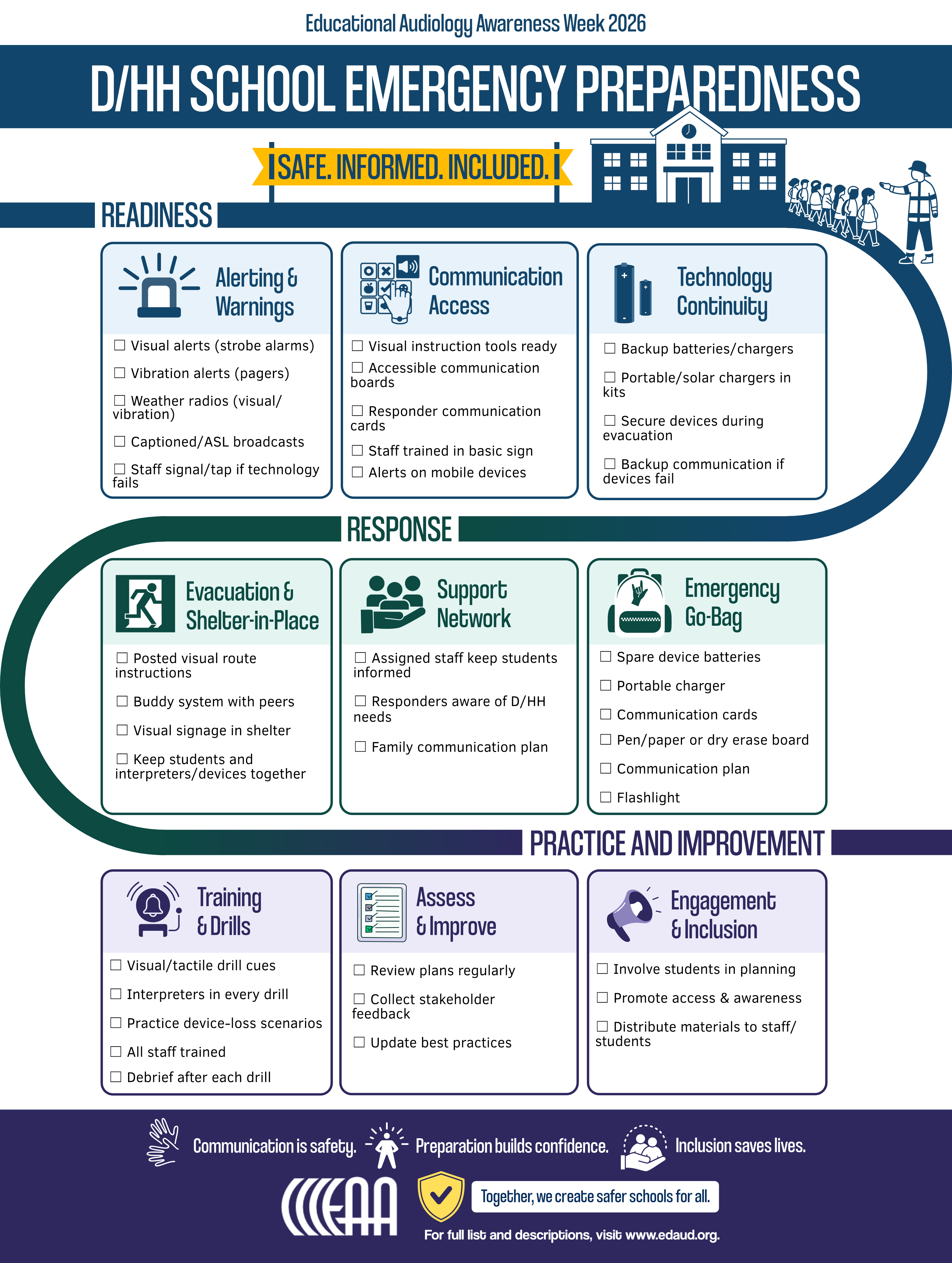
Select the image to open it at full size. The infographic groups the checklist below into three phases: readiness, response, and practice and improve.
The checklist
How to use this checklist
- Work through it with the team that would actually run a drill: teacher, administrator, interpreter, educational audiologist, and the student.
- Anything you cannot check is an action item, not a failure. Assign it a name and a date.
- Revisit it after every drill, and after any change in a student's devices or communication plan.
Section 1 Accessible Alerting and Warning Systems
- Classroom has visual alerts, for example strobe fire alarms
- Vibration based alerts available, such as pagers or bed shakers
- Emergency broadcasts include captions or ASL access
- Staff assigned to visually signal or tap students if technology fails
Section 2 Communication Access During Emergencies
- Whiteboards, printed cards, or other visual tools ready for instructions
- Pre-written emergency communication cards available for first responders
- Staff trained in basic ASL or communication strategies for emergencies
- Students know how to receive alerts on their mobile devices
Section 3 Assistive Technology and Hearing Device Continuity
- Backup batteries and chargers stored in the classroom
- Portable or solar chargers included in evacuation kits
- Procedures in place to secure hearing devices during evacuation
- Alternative communication methods available if devices fail
Section 4 Evacuation and Shelter-in-Place Procedures
- Visual instructions for evacuation routes and shelter areas posted
- Buddy system established with trained peers
- Visual signage present in evacuation and shelter zones
- Staff trained to avoid separating students from interpreters or devices
Section 5 Classroom and Environment Preparedness
- Visual alerting systems installed and functioning, flashing or vibrating
- Weather radios connected to visual or vibration outputs
- Communication boards accessible in the classroom and in evacuation areas
- All staff trained in basic emergency communication strategies for D/HH students
Section 6 Community and Support Network Integration
- Assigned staff or peers responsible for keeping students informed during rapid changes
- Emergency responders aware of D/HH communication needs
- Family communication plan covering captioned alerts, ASL access, and text based updates
Section 7 Training, Drills, and Practice
- Drills include visual and tactile cues
- Interpreters participate in all emergency drills
- Practice scenarios for device loss or interpreter separation
- Debrief after each drill to identify improvements
Section 8 Emergency Go-Bag for D/HH Students
- Extra hearing device batteries
- Portable charger
- Laminated communication cards
- Pen and paper or a dry-erase board
- Copy of the student's communication plan
- Flashlight
Section 9 Continuous Assessment and Improvement
- Safety plans reviewed regularly
- Feedback collected from students, families, staff, and involved community members
- Best practices updated as new guidance becomes available
Section 10 Engagement and Inclusivity
- D/HH students involved in planning and decision making
- School culture promotes communication, access, and awareness
- Educational materials distributed to staff and students
References
Suggested citation
Educational Audiology Association. (2026). Emergency preparedness checklist for teachers supporting deaf and hard of hearing students. https://www.edaud.org
Keep Exploring
Where It Came From
This resource was developed for the annual awareness week campaign.
See the campaign →
By Topic
Guidance and resources for supporting students and their families directly.
View topic →
|